Home / Stories / Making a Country
The Red River Resistance: Louis Riel, the Métis, and the Fight That Made Manitoba a Province
Canada bought the northwest in 1869 without asking the people who lived there. The Métis of Red River, led by Louis Riel, stopped the transfer, formed a government, wrote a List of Rights, and negotiated Manitoba into existence, at a cost that followed Riel to the gallows.
The short answer
In 1869 Canada bought Rupert's Land from the Hudson's Bay Company without consulting the roughly 12,000 people who lived at Red River. Led by Louis Riel, the Métis formed a provisional government, wrote a List of Rights, and negotiated Manitoba into Confederation as a province in 1870.
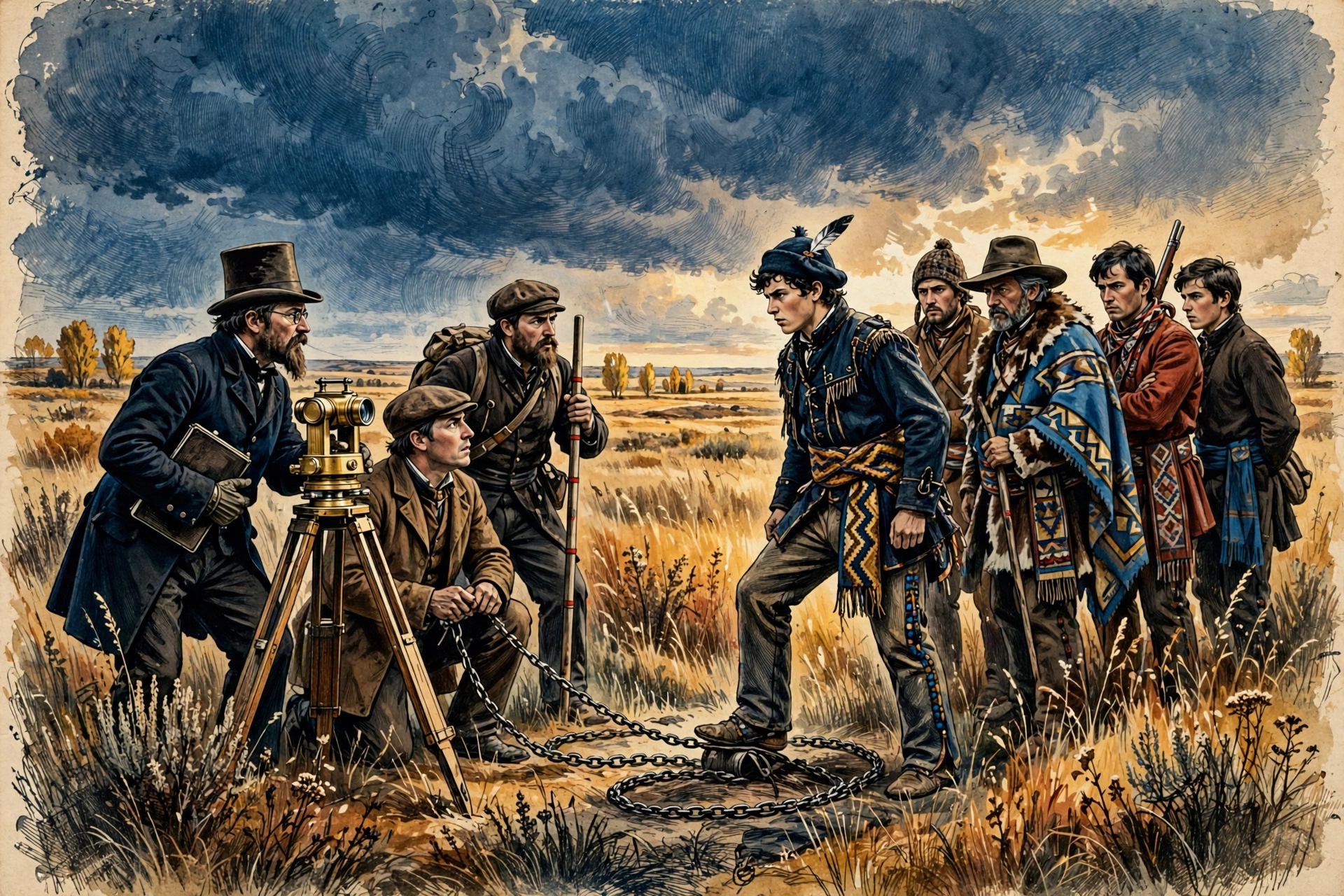
On an October day in 1869, a party of Canadian surveyors was driving chains and stakes across a Métis farm near the Red River when the work stopped in a way surveyors remember. Louis Riel, a twenty four year old Métis man lately returned from his studies in Montreal, stepped onto the surveying chain and, in the name of his people, told the crew to halt. The meaning was exact. The surveyors were laying out the land in the square township grid used in Ontario, straight across farms the Métis had worked for two generations in the long river lot pattern of old New France, narrow strips running back from the river so that every family had water, hay, and road. A grid drawn without reference to those farms was not a technical detail. It was the visible first stroke of a takeover, and the man standing on the chain was announcing that the takeover would not proceed as if the country were empty. Within eight months, the people of Red River had stopped a land transfer between a chartered company and a new dominion, formed a government of their own, written down their terms, and negotiated a province into Confederation on those terms. They had also executed a prisoner named Thomas Scott, and that act, defended at Red River as law and denounced in Ontario as murder, would shadow everything the resistance won.
A country sold over its people’s heads
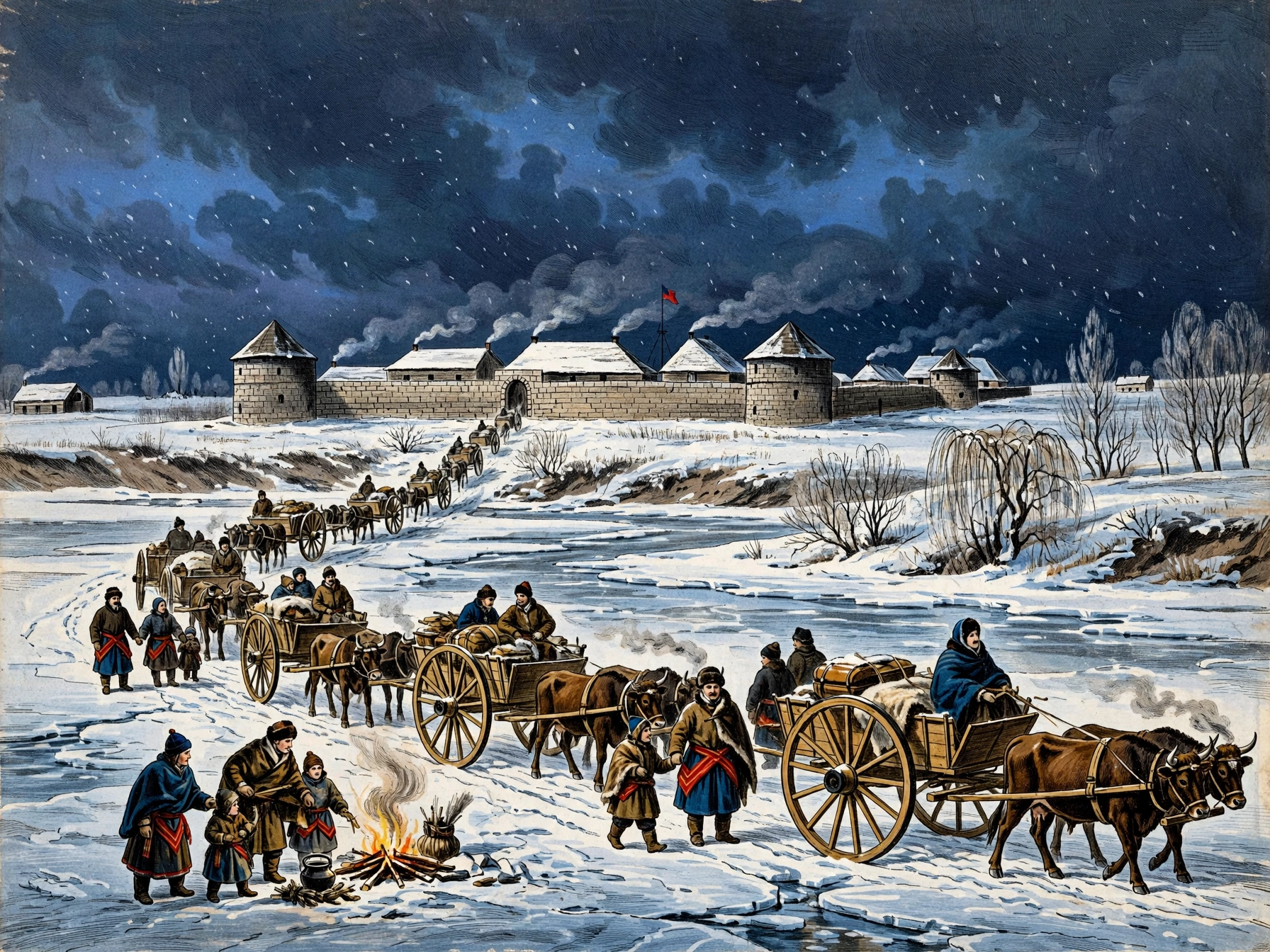
The vast territory called Rupert’s Land, draining into Hudson Bay, had been granted by the English Crown to the Hudson’s Bay Company in 1670 and governed by the company, lightly and commercially, for two centuries. At the forks of the Red and Assiniboine Rivers, where Winnipeg now stands, a distinct society had grown up in the company’s shadow. Its heart was the Métis, a people in the full sense of the word, born of unions between European fur traders and women of the Cree, Ojibway, and other First Nations, who by 1869 had their own language in Michif, their own parishes, their own buffalo hunt brigades with elected captains and laws of the hunt, and a settled conviction, earned over generations, that this river country was theirs. Around them lived Scottish settlers descended from Lord Selkirk’s colonists of 1812, First Nations whose title to the territory had never been surrendered by treaty, and newcomers from Ontario, some of whom arrived openly contemptuous of the French speaking, largely Catholic Métis majority.
In 1869 the company agreed to surrender Rupert’s Land to the new Dominion of Canada for 300,000 pounds sterling and large tracts of retained land, in a bargain negotiated in London. Prime Minister John A. Macdonald’s government planned the transfer for the first of December, 1869, and appointed William McDougall as lieutenant governor. What nobody in London or Ottawa did, at any point, was consult the roughly 12,000 inhabitants of the Red River Settlement about the sale of the country they lived in or the fate of the farms they had cleared. Métis accounts of the period, recorded in memoirs and petitions, return to this point with a consistency that Ottawa’s own correspondence quietly confirms. The people of Red River learned of their transfer as a fact decided elsewhere, and Macdonald himself worried in private letters that the population had been mishandled.
The survey parties came first, in the summer of 1869, before the transfer was even legal, chaining the grid across occupied river lots. In Ottawa’s stated position, the surveys were routine preparation for settlement and no settler’s title was in danger. In the Métis position, stated at the time and maintained ever since, a government that meant to honour existing farms would have surveyed those farms first and asked questions before driving stakes. What is not in dispute is the sequence. Canada sent surveyors before it sent any assurance, and the assurance, when demanded, never quite arrived.
A committee, a fort, and a government
The response was organized with a speed that surprised Ottawa. In October 1869 Métis leaders formed the National Committee of the Métis, with John Bruce as president and Riel, educated, bilingual, and burning with a sense of providential mission, as its secretary and driving voice. When McDougall attempted to enter the territory on the first of November, a Métis party met him at the border and turned him back, an extraordinary act aimed at a governor who had no authority yet, since the transfer had been delayed and the company still formally governed. The next day, the second of November, 1869, Riel’s men occupied Upper Fort Garry, the company’s post at the forks, without bloodshed. Whoever held the fort held the settlement’s food stores, its trade, and its symbolism, and now the committee held it.
Ottawa’s position, as Macdonald framed it, was that order must be restored and the transfer completed, but his government had no troops within a thousand miles in winter and was in the embarrassing posture of having bought a country it could not enter. The Métis position, as Riel framed it in proclamations and in the settlement’s newspaper, was the opposite of rebellion in intent. They proclaimed loyalty to the Crown, denied that they opposed joining Canada, and insisted they would enter Confederation only as free partners who negotiated their terms, not as a purchased population handed over with the fur stores. In December the committee became a provisional government, and Riel insisted it represent the settlement whole, with the English speaking parishes invited to take an equal share of seats, because a government of the Métis alone could neither claim the settlement’s consent nor negotiate in its name.
That winter the provisional government governed. It kept order, ran a newspaper, issued its authority in two languages, and drew up, through an elected convention of forty delegates, French and English speaking in equal numbers, the document at the centre of the whole episode, the List of Rights. The list demanded that the territory enter Canada as a province, with its own legislature, with official status for both French and English in the legislature and courts, with publicly funded Catholic and Protestant schools, with existing land titles confirmed, with 1.4 million acres, as the final settlement provided, for the children of the Métis, and with amnesty for actions taken during the troubles. The list arrived in Ottawa carried by three Red River delegates, including Judge John Black and the priest Noël Joseph Ritchot, and much of it, to the government’s discomfort, was simply granted.
Thomas Scott and the price of one morning
Against that achievement stands the event that poisoned it. Not everyone at Red River accepted the provisional government. A small armed faction of newcomers from Ontario, loosely called the Canadian party, plotted against it through the winter and was arrested more than once. Among the prisoners the government held in Fort Garry was Thomas Scott, a young labourer from Ontario and a member of the Orange Order, who in the government’s account assaulted his guards, abused and threatened his captors, and was charged with treason against the provisional government. A court martial of Métis officers tried him, with Ambroise Lépine presiding. Scott was sentenced to death, and on the fourth of March, 1870, despite appeals for mercy from, among others, Donald Smith, the company officer who was also negotiating for Canada, Riel refused to commute the sentence and Scott was shot at the wall of Fort Garry.
The two judgements of that morning were delivered at once and have never reconciled. At Red River, and in Métis memory since, the execution was the act of a lawful government asserting its authority against armed insurrection, at a moment when mercy toward a violent prisoner might have taught the factions that the government could be defied at will. Riel later maintained that Canada needed to be shown the Métis were a people to be reckoned with. In Ontario, the same act was received as the murder of a Protestant, English speaking Canadian by a French Catholic rebel government, and the Orange Order, a powerful force in Ontario life, turned Scott into a martyr and the demand for Riel’s punishment into a test no Ontario politician could ignore. Macdonald’s government, needing Ontario, let the amnesty Red River’s delegates believed they had secured dissolve into delay. That unresolved amnesty is the hinge between the victory of 1870 and the tragedy of 1885.
A province made by negotiation, and a leader in flight
The Manitoba Act received royal assent on the twelfth of May, 1870, and on the fifteenth of July the small postage stamp province of Manitoba entered Confederation as its fifth province. Nearly everything in the act traces to the List of Rights. Provincial status, bilingual institutions, denominational schools, confirmation of existing titles, and 1.4 million acres set aside for Métis children. A territory that Canada had bought as a colony entered instead as a province with constitutional protections, because its people had organized, governed plausibly, and negotiated from a fort they had the wit to seize before anyone was killed.
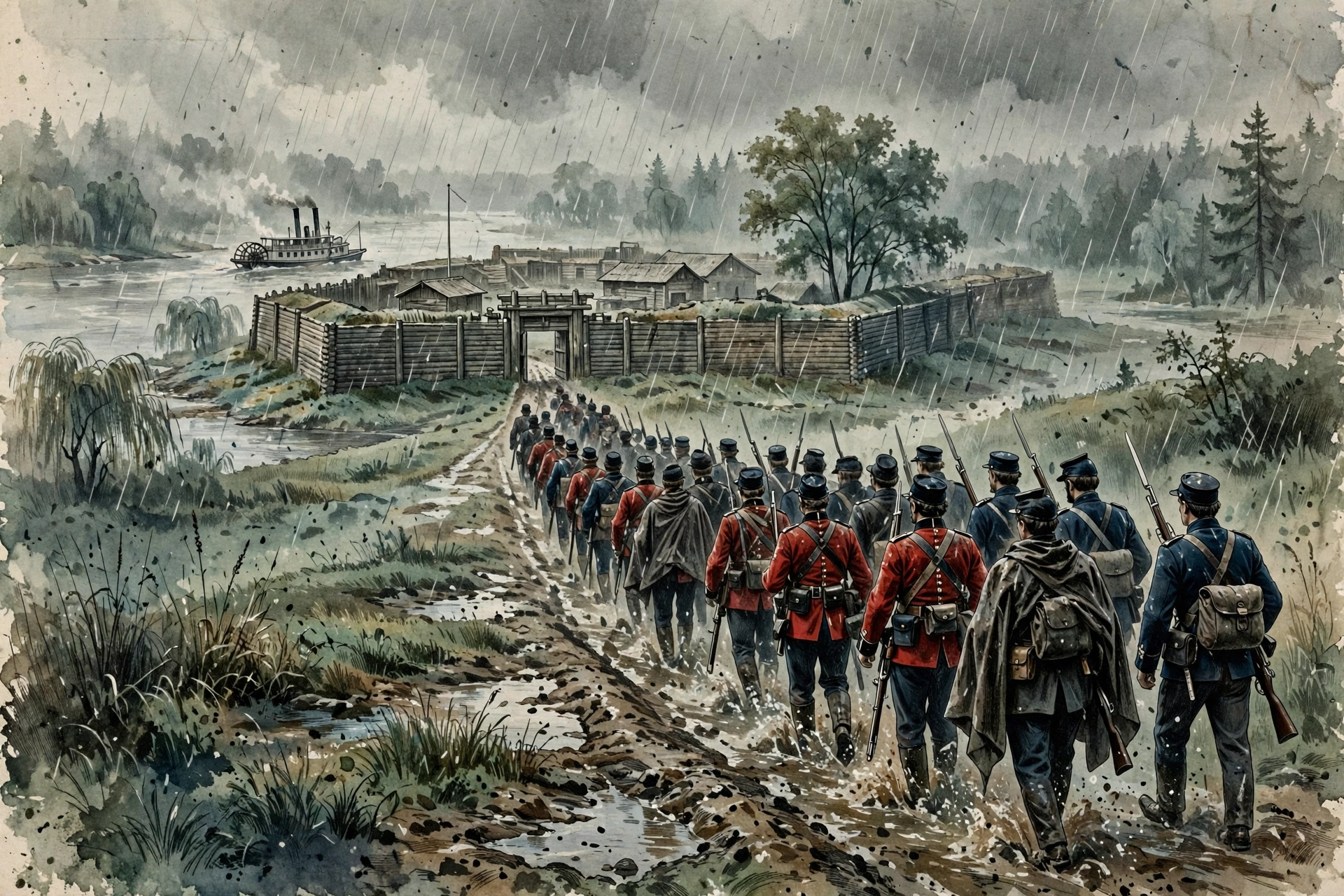
Then the soldiers came. Because the amnesty had failed, Ottawa dispatched a military expedition under Colonel Garnet Wolseley, officially to uphold authority in the new province, and many of its Canadian militiamen came west, in their own memoirs’ frank wording, thirsting for Riel’s blood after Scott. The expedition reached Fort Garry on the twenty fourth of August, 1870, and found the fort empty. Riel, warned in time, had crossed the river and ridden for the American border hours before. In the months that followed, Métis accounts and contemporary reports record beatings and intimidation of Métis by expedition members and incoming settlers, and at least one Métis supporter of the government, Elzéar Goulet, died fleeing pursuers in the river. The land promise then unraveled in administration, as scrip speculation, delay, and outright fraud stripped most Métis families of the 1.4 million acres within a generation, and many Red River Métis drifted west to Saskatchewan, where, fifteen years later, they would call on the exiled Riel one final time.
The legend vs. the record
Two legends fight over this story, and both fail the record. The older legend, fixed in Ontario memory for a century, casts Riel simply as a rebel and murderer and the resistance as a French Catholic rising against the natural progress of Canada. The record contradicts it at every joint. The provisional government was bilingual and deliberately half English speaking in its convention, it professed loyalty to the Crown, it kept remarkably good order, and its central demand was entry into Canada as a province rather than submission as a colony. Parliament enacted its core terms into law. A rebellion that ends with the rebels’ program in the statute book deserves a more precise word, and historians have largely settled on the one the Métis themselves now use, resistance.
The newer legend, the mirror image, casts Riel as a flawless founder and the resistance as an unclouded triumph, which the record also refuses. Thomas Scott was a prisoner, tried by his enemies in an afternoon, for offences that even sympathetic historians concede were stretched to reach a capital verdict, and his execution was a political catastrophe. The amnesty was never secured in writing, a failure with fatal consequences deferred, not avoided. And the province won on paper was substantially lost in the land offices, so the Métis gained Manitoba and, within a generation, largely lost it. A telling that omits Scott flatters. A telling that omits the Manitoba Act slanders. The record contains both, a people who negotiated a province into existence and a leader whose gravest decision that winter helped ensure he would die on a scaffold at Regina in November 1885, hanged for treason after the second, far more violent resistance in Saskatchewan, with Scott’s name spoken in the arguments against mercy. Nor did Riel create Manitoba single handedly, whatever the statues imply. The List of Rights was the work of forty delegates, and the negotiations in Ottawa were carried by Black, Ritchot, and Alfred Scott, while Riel remained at the fort. His genius was real. It was a collective people’s genius first.
Why it still matters
Manitoba begins here, and knows it. The province marks Louis Riel Day on the third Monday of February, and the legislature the List of Rights demanded stands in Winnipeg within sight of the forks where the fort stood. In 2024 the Government of Manitoba passed legislation recognizing Riel with the honorary title of the province’s first premier, a formal correction, a century and a half late, to the old habit of calling the man who negotiated the province into being merely its rebel. The Manitoba Act still works in the constitution. Its language guarantees, struck down in practice for most of a century, were restored by the Supreme Court in 1979 and 1985, so a bargain struck in a fort in 1870 continues to decide cases in modern Manitoba courtrooms.
For the Métis Nation, the resistance is a founding proof, carried into modern law. When the Supreme Court ruled in the Manitoba Metis Federation case in 2013 that the Crown had failed to implement the Manitoba Act’s land promise honourably, the court was, in effect, reading the List of Rights across 143 years and finding the obligation still alive. The descendants of the families who watched surveyors cross their farms now negotiate as a recognized Indigenous people with governments that once bought their homeland without a knock on the door.
That is the durable lesson of Red River, and it is bigger than one province. In 1869 a dominion tried to acquire a homeland the way a company sells a warehouse, land, stores, and people in one instrument, and the people, who had not been consulted, answered with the most Canadian of revolutions. They formed a committee, elected a convention, wrote a list, and asked to join the country on written terms. Confederation was not only proclaimed in Charlottetown and Quebec City. It was also negotiated, under pressure, by the Métis of Red River, who insisted that entering Canada was something a people did, not something done to them.
Common questions
Who was Louis Riel?
Louis Riel was a 24 year old Métis leader, educated in Montreal and bilingual, who became the driving voice of the Red River Resistance. In October 1869 he famously stepped onto a survey chain to stop Canadian surveyors crossing Métis farms, then helped lead the provisional government that negotiated Manitoba into Confederation.
Why did the Red River Resistance happen?
Canada and the Hudson's Bay Company negotiated the transfer of Rupert's Land in London without consulting the people of Red River. Canadian survey parties then arrived in the summer of 1869 and began laying a square township grid across Métis river lot farms, a visible sign their land and way of life could be taken without their consent.
What was the List of Rights?
The List of Rights was the Métis provisional government's negotiating document, drawn up by an elected convention of forty delegates, French and English speaking in equal numbers. It demanded provincial status, bilingual institutions, Catholic and Protestant schools, confirmation of existing land titles, 1.4 million acres for Métis children, and amnesty for actions taken during the troubles.
Who was Thomas Scott and why was he executed?
Thomas Scott was a young labourer from Ontario and a member of the Orange Order held prisoner at Fort Garry after plotting against the provisional government. A Métis court martial tried him for treason, and he was shot on March 4, 1870 after Riel refused to commute the sentence, an act Ontario received as murder.
Sources
Every story on this site ends with the sources it was built from. Check us.
- Red River Resistance — The Canadian Encyclopedia
- Louis Riel — The Canadian Encyclopedia
- Manitoba Act — The Canadian Encyclopedia
- 150th Anniversary of the Red River Resistance — Parks Canada
- Thomas Scott — The Canadian Encyclopedia